|
AI and Robotics
|
Robots are known to operate independently in an autonomous
state, with minimum human assistance. This essentially
requires robots to have intelligence. Based on type of
robot, unique intelligent software, algorithms and hardware
is embedded. The well know AI features that are used in
robotics are:
- Vision, Image Processing and Pattern Recognition
- Machine Learning
- Proximity Sensing
- Obstacle Avoidance
- Voice Recognition
- Autonomous Path Generation (shortest path)
- Intelligent Material Handling
|
|
Vision, Image Processing and Pattern Recognition
|
|
For robots to operate autonomously, they need to be
capable of analyzing objects, images and anything
that is in its path. The robot camera needs to
create a 3D-image of the object and compare it
against image data it has in memory. The
image/object comparison involves pattern
recognition. Based on the analysis, it has to take
actions.
|
| |
|
Machine Learning (ML)
|
|
To operate autonomously, a robot has to analyze each
situation - vision, motion, operation etc. and use
existing (training) data to perform its operational
tasks. Robotic software has embedded ML algorithms
to achieve this.
|
| |
|
Proximity Sensing
|
|
Robots have proximity sensors to guide their motion,
compute distance and time to reach a specific
location. This is hardware based intelligence
implemented by
IR
sensors,
radar,
laser
and
lidar
based devices. Software is used in computation of
various parameters.
|
| |
|
Obstacle Avoidance
|
|
Robots have to avoid obstacles that are in the path
of traversing of the arm (industrial robots) or in
the path of autonomous robots. Along with hardware
and sensors, the robots are embedded with object
tracking software with algorithms that achieve
collision avoidance with objects.
|
| |
|
Voice Recognition
|
|
Robots used in military, search and rescue type
of operations need to have sensors that can
recognize sounds, voice, audio frequencies
and analyze them. Further robots need to locate
position from where the audio frequencies are
getting generated. They can analyze audio
frequencies beyond human cognitive range. The
robots then create routes to reach the location
of the audio frequencies in search and rescue
mission.
|
| |
|
Autonomous Path Generation (shortest path)
|
|
Robots move from point A to point B during their
operation. The shortest path between two points
is a straight line. However there will be obstacles
in this path. Using proximity, vision and other
sensors, they compute how to
maneuver around objects, avoid obstacles, map
different paths and finally chose the shortest
path. The shortest path is computed by a
combination of hardware and software algorithms
(such as
TSP,
Dijkstra's algorithm, A* algorithm)
to achieve an
intelligent solution.
|
| |
|
AGV
|
|
AGVs are autonomous robots that typically transport heavy
weight manufacturing components such as engine assembly,
gearbox assembly etc. in automotive industries. They are
also used in warehouses to move boxes to delivery locations
or bring parts to be stored in racks. These robots have
proximity
IR sensors,
vision cameras, payload lifting mechanisms and software
for autonomous mapping of paths. All these features are
enabled using various AI software algorithms and suitable
hardware.
|
| |
|
Industrial Robots
|
|
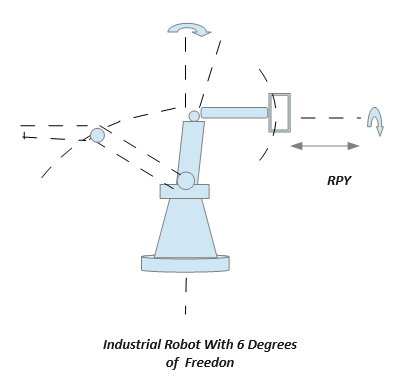
Industrial robots are typically installed in a manufacturing
assembly line with enough degrees of freedom (DOF) to operate
in a versatile manner. They are used in hardware,
PCB
assembly, cleanroom assembly, in automotive manufacturing -
frame welding, painting, inspection, and many similar
assembly activities. Based on the type of usage, the
robotic hand will be configured with specific intelligent
devices. In most industrial robots, the basic motion is
controlled by stepper motors, the robot arms can have
proximity sensors, vision sensors, gripping (hand) devices
have tactile sensors and fingers as needed for
RPY.
|
| |
|
| |
|
Custom Robots
|
|
Robots used in surgery are customized version of industrial
robots. They need to have enough degrees of freedom to operate
on humans with dexterity. Currently these robots are remotely
operated by surgeons. They have several robotic arms and
hands based their surgical usage with sensors and actuators.
These robots have high resolution cameras, tactile sensors,
software with shortest path algorithms and perform surgery
with high dexterity. It is only matter of time, advancements
in AI and in related technology, they will operate in more
autonomous modes (less human intervention).
|
| |
|
Many airports in US and around the world are slowly introducing
Robotic Wheel Chairs. These robotic devices
have the latest hardware, sensors, software and AI algorithms
to nagivate to a specific terminal. With latest technology,
they can auto-communicate to the terminal staff if there is a
delay, chose the shortest path, be on time and in a autonomous
mode.
|
| |

|
| |
|
Custom robots are used in military operations. The land/ground
based robots are similar to AGVs, but they can travel in
any direction. These robots have high resolution thermal
imaging cameras, tactile sensors, AI software with shortest path
algorithms and related hardware. Those used in bomb defusion
also have chemical property tracing capabilites and
GPR.
|
| |
|
Humanoid Robots
|
|
As the name suggests, these resemble humans, move autonomously
and behave similar to humans. Currently these type of robots
are used in security, customer support, toll booth and similar
areas. As these types of robots move around freely and
behave like humans, they require state of the art hardware and
AI based software. They are equipped with camera for vision,
motors and actuators for movement, obstacle avoidance software
and algorithms, pattern recognition algorithms, IR-sensors,
sound and voice recognition/communication systems to perform
at human like manner.
|