|
1923:
|
Rossum's Universal Robots, a play created by Karel Capek was started in
London. The term robot, derived from Czech word "robota" was first
used, which meant "forced labor" or "serf".
|
|
1944:
|
Concept of Neural Network, proposed by Warren McCullough and Walter Pitts
(University of Chicago)
|
|
1950:
|
Turing Test, Concept of thinking machines, Computing Machinery and Intelligence - Alan Turing.
|
|
1951:
|
Creation of first AI program
|
|
1956:
|
The Term Artificial Intelligence proposed by
John McCarthy of MIT and
Marvin Minsky of CMU
popularized it
|
|
1957:
|
Organization of a Perceptron - Frank Rosenblatt
|
|
1958:
|
LISP
programming language was developed by John McCarthy while working at
MIT
|
|
1964:
|
Daniel G. Bobrow created a rule-based AI program STUDENT,
as a part of his PhD dessertation at
MIT
in
LISP
to solve algebraic word problems. This program and research
is considered as a earliest implementation of
NLP
|
|
1965:
|
Eliza - The first chatbot that used
NLP created by Joseph Weizenbaum at
MIT
|
|
1970:
|
Freddy - The Robot, was created at the Department of
Artificial Intelligence, University of Edinburgh.
|
|
1972:
|
Shakey - The Mobile Robot, was created at Artificial Intelligence
research center of
SRI
between 1966 and 1972
|
|
1980:
|
Autonomous vehicle was tested by Mercedes-Benz
|
|
1985:
|
Robot used brain surgery to place a needle in a precise
location.
|
|
1997:
|
Kismet - The Robot, created by Dr. Cynthia Breazeal, of
MIT,
that would recognize and simulate emotions
|
|
1997:
|
IBM Deep Blue computer defeats world chess champion Gary Kasparov
|
|
2000:
|
FDA approves robotic surgery for laparoscopic procedures using surgical robot
|
|
2003:
|
Opportunity - Robotic Rover created for NASA Mars exploration
(followed by Curiosity in 2011/2012)
|
|
2011:
|
IBM Watson defeats Jeopardy champion Ken Jennings (who had
a records of 74 consecutive wins) and Brad Rutter
(Tournament of Champion winner)
|
|
2015:
|
Baidu's Minwa supercomputer, using
Convolutional Neural Network is
able to recognize and categorize images -
implementation of facial recognition
|
|
2016:
|
DeepMind's AlphaGo program, that is based on
Deep Neural Network
defeats Lee Sodol, the world champion
Go player in best of five games.
|
|
2017:
|
Transformer concept published
[20]
|
|
2020:
|
GPT-3, released by OpenAI
|
|
2022:
|
ChatGPT (chat GPT)
is developed by OpenAI that uses
LLM to
analyze user input/prompts and provide best possible answer
|
|
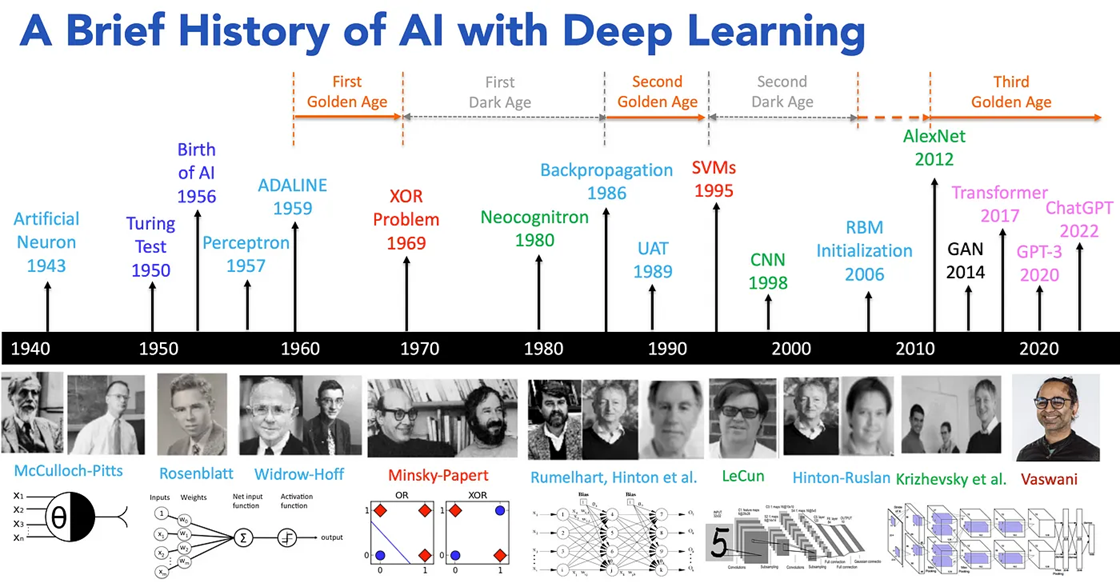
Evolution of AI and Related Technologies Over the Years
[26]
|
|
| |
|
At every milestone shown above, AI was implemented by
the use of thinking algorithms, machine learning,
logical decision making, heuristics and related
AI enabling technologies
such as NLP, machine vision, pattern recognition, neural
networks, feedback sensors and so on. Major advances in
electronic hardware, memory was also in progress during
these times.
|
| |
|
There was also a time when the computer harware was
in the early stages of development. The results of
massive matrix and tensor computation was slow.
This resulted in reduced research funding for AI.
These times were know as
AI Winters.
|