|
Hardware and Software
|
|
For AI to succeed, high speed computing is a basic
necessity. The data needs to be constantly gathered
by a system. Using mathematical and statistical
algorithms, decisions have to be made in realtime.
Data from any new or unknown
situation needs to be synthesized using specific
algorithms and made as new model or update existing
model, which becomes a part of the constant learning
process.
|
| |
|
Analysis of Natural Intelligence
|
|
An animal running in a certain terrain in a forest
will react to jump over an obstacle or turn away
using its natural intelligence spontaneously. The
AI provides the tools and technology for a machine
to achieve or mimic such intelligence. For a
machine (robot) to perform such maneuvers operating
autonomously, AI algorithms have to -
|
| |
|
1. Compute the speed by electronic devices/sensors
|
|
2. Constantly make adjustments to speed based
on distance computed using
radar
|
|
3. Avoid obstacles using vision (camera,
hardware, IR-sensors, and software)
|
|
4. Constantly adjust mechanical devices
that perform functions of legs or motion
systems based terrain
|
|
5. Autonomous tasks such as stop, slow
down, maintain speed, accelerate, or
jump over obstacles
|
|
6. Think and make spontaneous decisions
using built-in AI in realtime
|
| |
|
At a high level, this lists the complexity involved
(intelligence, cognitive analytics) that needs to be
incorporated into a robot or autonomous device. The
system also has to learn from new situations it
encounters on a constant basis.
|
| |
|
Graduate School Research
|
|
During graduate research on
Robotic Dexterous Hand
several years ago, I encountered this issue when
simulating grasping objects such as a ball by the
dexterous hand using software. The software
simulation of mechanical grasping of was a success.
The dexterous hand was taught (in machine learning
terms it is similar to supervised learning) to
grab hard balls such as a baseball. The software
simulation was mechanically tested using a
industrial robotic gripper with three fingers.
|
| |
|
The big challenge encountered was when suddenly the
object to grasp was switched from baseball to an
egg or a ping-pong ball in a demo robot with same
robotic gripper with fingers. Without AI
(intelligent decision making algorithms) and also
due to lack of visual feedback to the robotic
gripper, the egg would get squashed. For the
dexterous hand or robotic gripper to seamlessly
hold objects autonomously without causing damage,
requires AI, machine learning algorithms, software
and hardware embedded with machine vision.
|
| |
|
Due to the computing power of the processors
in the 1980s, the actions weren't spontaneous,
resulting work-around solutions to embed
intelligence or prevent mixing of objects.
Thus many industrial robots would perform
pre-programmed operations
(weak form of AI) with optimum speed.
|
| |
|
Computing Power Overview
|
|
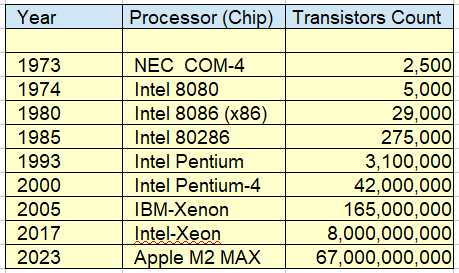
The table below shows how number of transistors in
a single microprocessor have increased steadily over
the years resulting in significant improvement in
AI. From 1970's to now there has been enormous
progress in the computational power due to
advancements in memory chip architecture
(CPU,
VLSI,
ULSI,
etc.) and technology. The number of transistors
started from 2500 in a chip in the 1970s to 67 billion
transistors in a single chip in 2023.
|
| |
|
| |
|
The IBM's deep blue supercomputer was able to
achieve the level of intelligence to defeat world
chess champion Gary Kasparov in a couple of games
in a tournament. Autonomous computers and machines
continue to evolve with enhancements in AI. As the
computing power and other technologies increases,
the evolution of AI will be exponential in the
future.
|
| |
|
| |
|
One of the CEO of an AI research company was expressing
how venture capital companies were ignoring funding of
AI and ML in 2010 and around. Going back further to
early
1990s, AI was considered as a fantasy and recruiters
would advice prospective clients to remove AI from the
resumes, whom they were promoting for job placement in
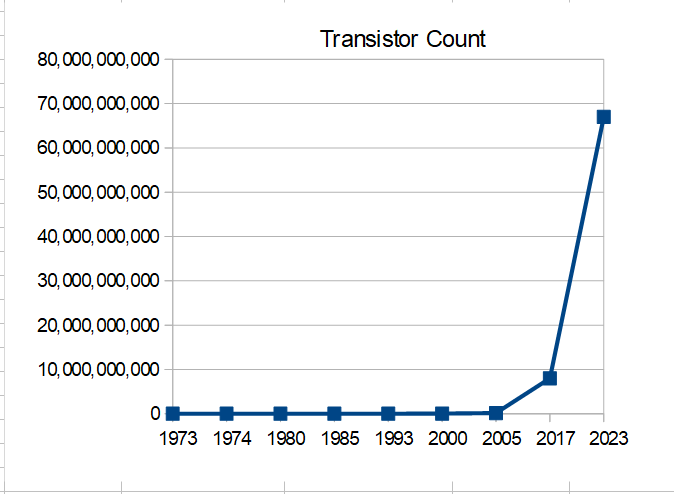
client companies. The above graph can be a good reason
that the computing power has made AI and ML a thing of
the present day.
|
| |
| Use of
FPGA
In AI
|
|
Some search engines used FPGA based hardware in enablement
of AI. The FPGA offered high performance/speed, throughput,
programmability, flexibility and cost benefits. The
development of FPGA hardware was fast. Around 2015, FPGA
based hardware was used in search engines such as Microsoft
Bing with AI features to enhance search ranking.
|
| |
| Advent of
GPU
|
Initially gaming computer hardware was heavily graphics and
video oriented to satisfy rapid graphics/video generation in
games. The GPUs were an amazing fit for such applications and
supporting hardware. GPU offered
- Parallel processing
- Performance that can scale upto supercomputer levels
- Perform complex arithmetic for AI/Machine Learning - deep learning
|
|
The GPU offered many more benefits compared to that of
standard CPU,
which resulted being a main choice for AI enablement in
computing, robotics, image recognition and many more
supercomputing systems and applications. The
MPP
in GPU have made them the best choice for vector/tensor
computation that involve massive matrix processing
and providing output in nanoseconds or better. Parallel
processing of large matrices is a key requirement in
neural networks.
|
| |
|
|
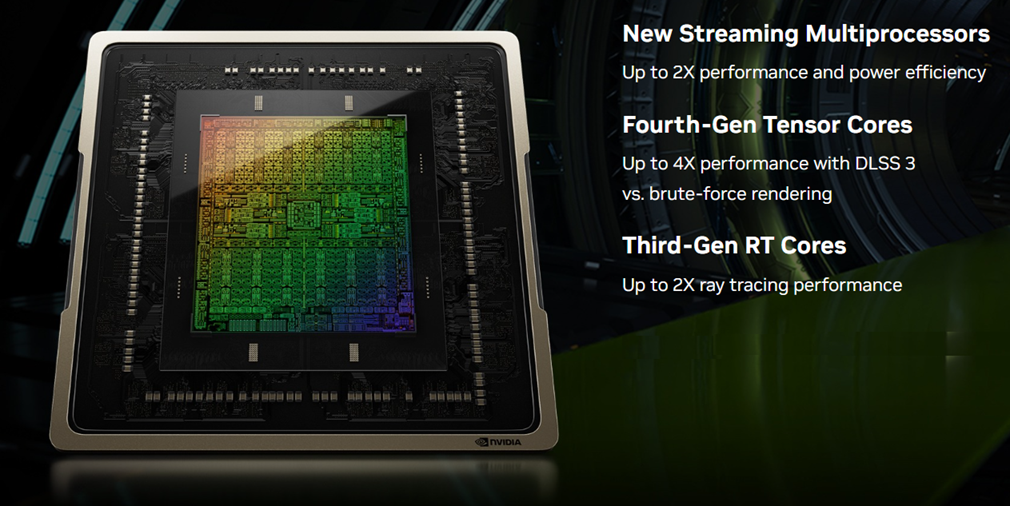
Typical NVDIA GPU Chip
|
| |
|
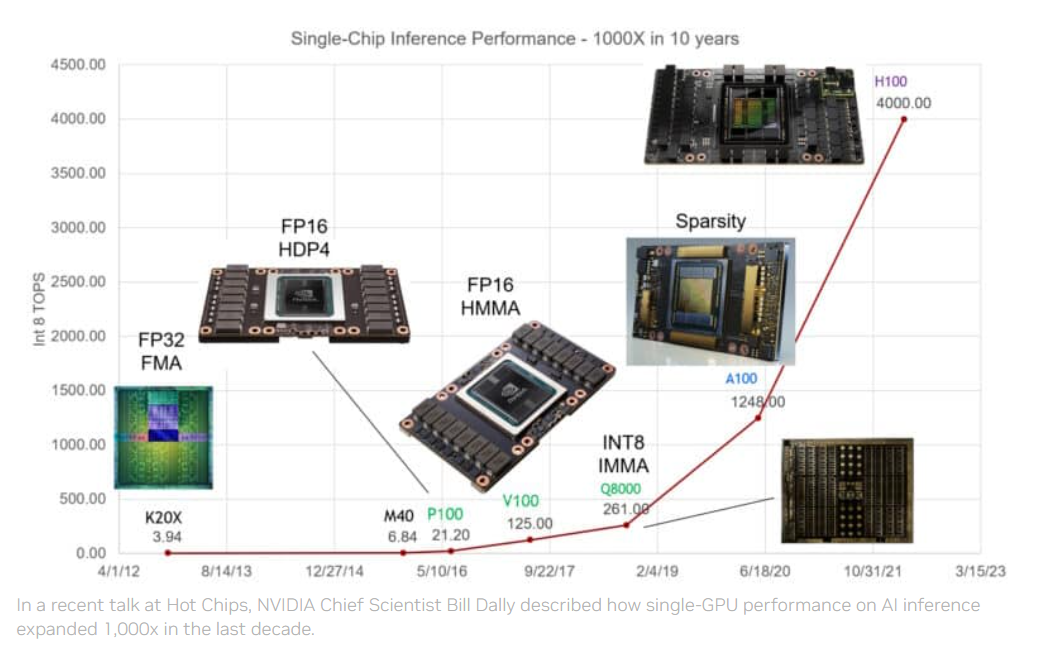
The NVDIA GPU chip performance is increasing at exponential
rates, from version to version. The performance is complemented
by the number of transistors that are packed into a single chip.
The NVDIA has several chip technology videos on youtube that
show how the high performance, parallel processing, and
computational power scaling is accomplised, from one version to
the next. This has lead to exponential rate success of NVDIA
and AI technology has be complemented by these supercomputing
GPU chipsets.
|
| |
|
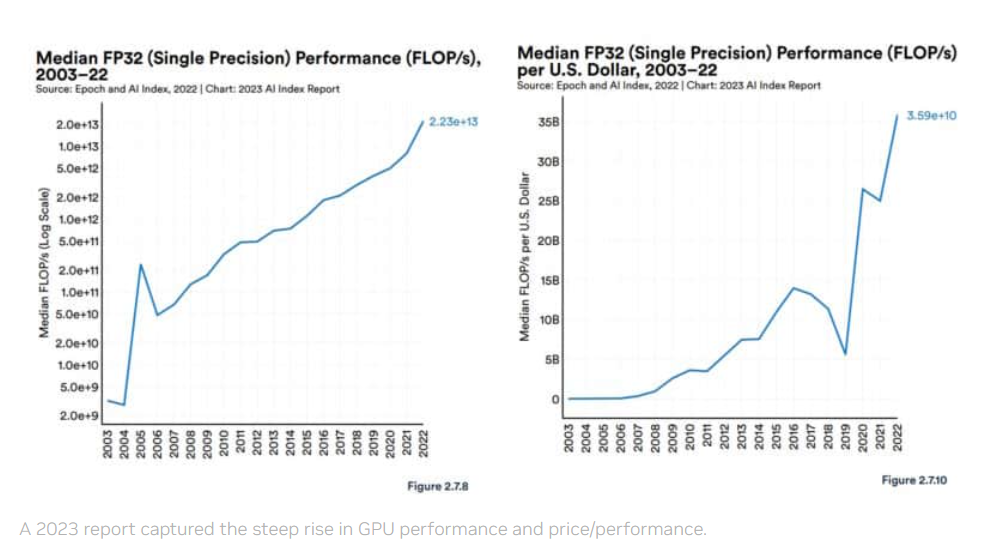
The graphs below show the performance improvement of
GPU over time (from 2003 to 2022). The performance
improvement is about approximately 7000 and price
per performance is about 5600 time higher. This
data is from Stanford’s Human-Centered AI group's
report on AI [15].
|
| |
|
| |
|
Another graph that shows the exponential improvement of
performance scaling of NVDIA GPU chips over time, in
FLOPS.
The rate at which the number of transistors are being
packaged in single chip is pushing the limits of the
well known
Moore's Law (Moore's law: the number
of transistors in an
IC
will double every two years). Multiple GPU chips are
also being merged to attain extreme rate of
parallelism and enhance computing power. There are
several videos of NVDIA's CEO showing simulation of
how it all happens.
|
| |
|