|
Machine Learning (ML)
|
|
The fundamental principle of AI is to enable autonomous
thinking and decision making based on prior knowledge.
This can be termed as building intelligence, enable
autonomous learning and decision making. The initial
data for computation in ML algorithms is
training data.
The ML algorithms use training data to predict/forecast
trends, prevent or warn potential fraud, and other
intelligent decision making business activities. In
machines such as robots, ML algorithms are used to
stop an action, avoid collision and take autonomous
actions that prevent or minimize missteps.
|
| |
|
Forecasting
|
|
Forecasting is used in many areas such as weather,
short and long term financial performance, stock
performance etc. In forecasting, statistical models
are used forecast future outcomes. Based on the
forecasted output humans make meaningful decisions.
There is no autonomous learning involved.
|
| |
|
In machine learning, the forecasted values are used as
the basis or
training data and for every new event.
New values are
predicted in a autonomous manner based on the newly
learnt values. This continously goes on, and analysis
can be made using multiple models.
|
| |
|
Expert Systems
|
|
In the 1980s, thinking machines were conceptually
known as expert systems. Expert systems were embedded
with enromous knowledge in specific areas - medical
diagnosis, research knowledge base etc. Based on
rule based algorithms, decision tree algorithms, and
other computational algorithms, the expert systems
would provide answers to user prompts. As explained
in earlier chapter
(Role of Hardware and Software),
the hardware and computing power had significant
impact on the success and real-time usage of expert
systems.
|
| |
|
With massive improvements in hardware, memory,
computing power and software, the AI based systems
such as ChatGPT, have come to
prominence. The analysis of a user prompt, getting
very accurate answers and data retrival speed has
enormously improved in the recent years. The
success of ChatGPT can be attributed to advances in
LLM.
|
| |
|
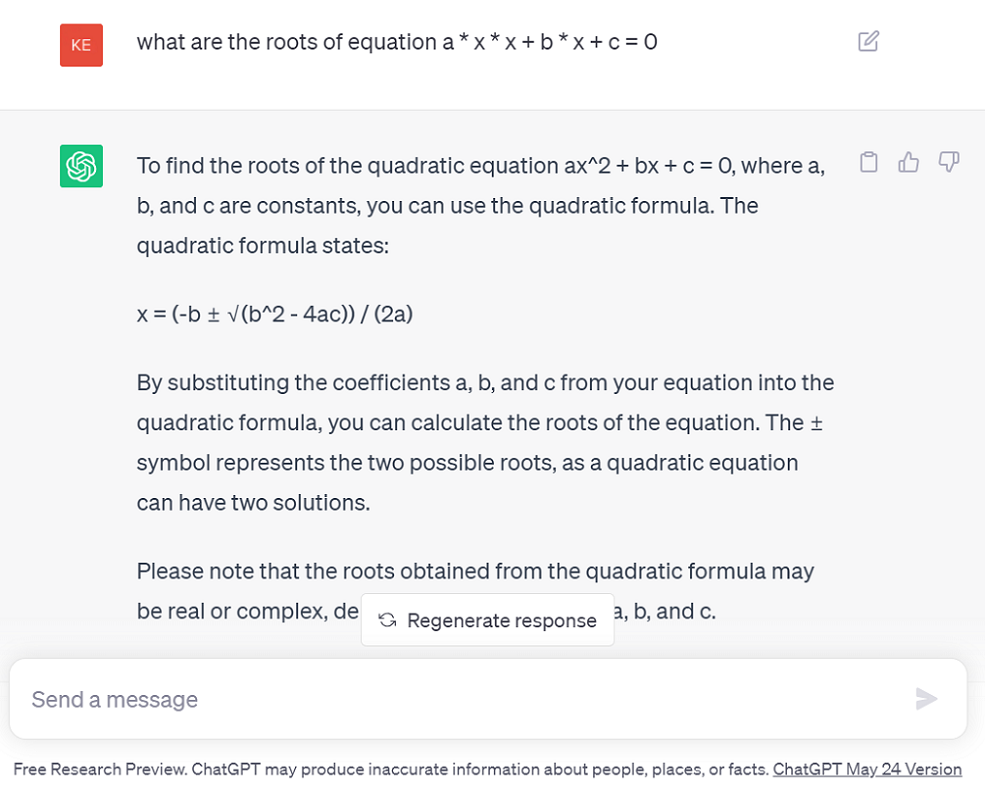
Here is an example of an accurate answer to a math
equation a x2 + b x + c = 0.
|
| |
|
| |
|
Machine Learning in Hardware
|
|
In industrial robots, the learning was achieved by
allowing the robot interface (computer system) to
record the motions of the robot by simulation software.
The robot is then tested on test manufacturing
processes. Any new location (in 3D co-ordinates),
grasping of objects, avoidance of obstacles
is updated in the system. This is basically training
data, to be used to perform operations in live mode,
when activated in an assembly line. There will also be
inter-communication data between robots to adjust
speed and times to keep constant flow of operations.
|
| |
|
The industrial robots need vision features to
achieve intelligence. Machine Vision
played a major role in robots working autonomously
and make intelligent decisions. Due to machine vision,
obstrucle avoidance, object grasping with high
precision, autonomus mobility to name a few, were
easily accomplished.
|
| |
|
In case of robots and autonomous vehicles, to avoid
obstacles,
real-time machine vision and intelligent decision
making
needs to happen. Spontaneous analysis
of an object (pattern/image recognition), its
dimensions, distance from current location, all in
3D needs to be computed to make a
accurate decision on how to maneuver around the
object (obstacle) or come to a stop. Along with
software,
IR-sensors,
radar,
and hardware is
required for image recognition and intelligent
decion making to happen in real time.
|
| |
|
Operating in autonomous mode also requires
computing the shortest path
and distance between starting location and
the destination (end point). One of the well know
algorithms used for this is
TSP.
This is a great solution in ideal an situation.
However, the next data to collect is the traffic
condition in chosen paths by this algorithm.
Now a new path has to be computed if there
are bottleneck or
traffic jam in the initial
path. To solve this issue, the TSP algorithm has
to be applied recursively to get a new path to
circumvent the traffic jam. Most
GPS devices
had this algorithm built in and we are used to
the well known message
"recalculating"
by these systems.
|
| |
|
There are other algorithms used to solve the
problem of shortest path generation between two
points. For efficient operation of this, both
existing data (training data) and machine learning
algorithms are in use - in realtime.
Refer [6]
for detail mathematical analysis of TSP
and other algoritms.
|
| |
|
Machine Learning in Software
|
| In the beginning, the data analysis was performed
by data mining, to understand trends,
forecasting, improve operational efficiency, scientific
research and many other areas. Statistical models
were used to analyze data by the use of statistical
software and related algorithms (eg.
MCMC).
The venn diagram shown below gives an overview of the
software and technology framework, that is a part of
machine learning.
|
| |
|
Data Mining, Machine Learning - Venn Diagram, [05]
|
![Machine Learning Venn Diagram [Refer 5]](../../images/architectureIT/machine-learning.png)
|
| |
|
Machine Learning In Banks and Financial Institutes
|
|
Financial institutions/banks use machine learning to
prevent fraud. The machine learning models analyze card
holder's buying pattern constantly. When there is a
extremely large amount of card purchase transaction,
it flags the transaction to stop the transaction. At
a high level following are the ML steps.
|